

Manhattan Quality Solutions ·
IN THIS ISSUE
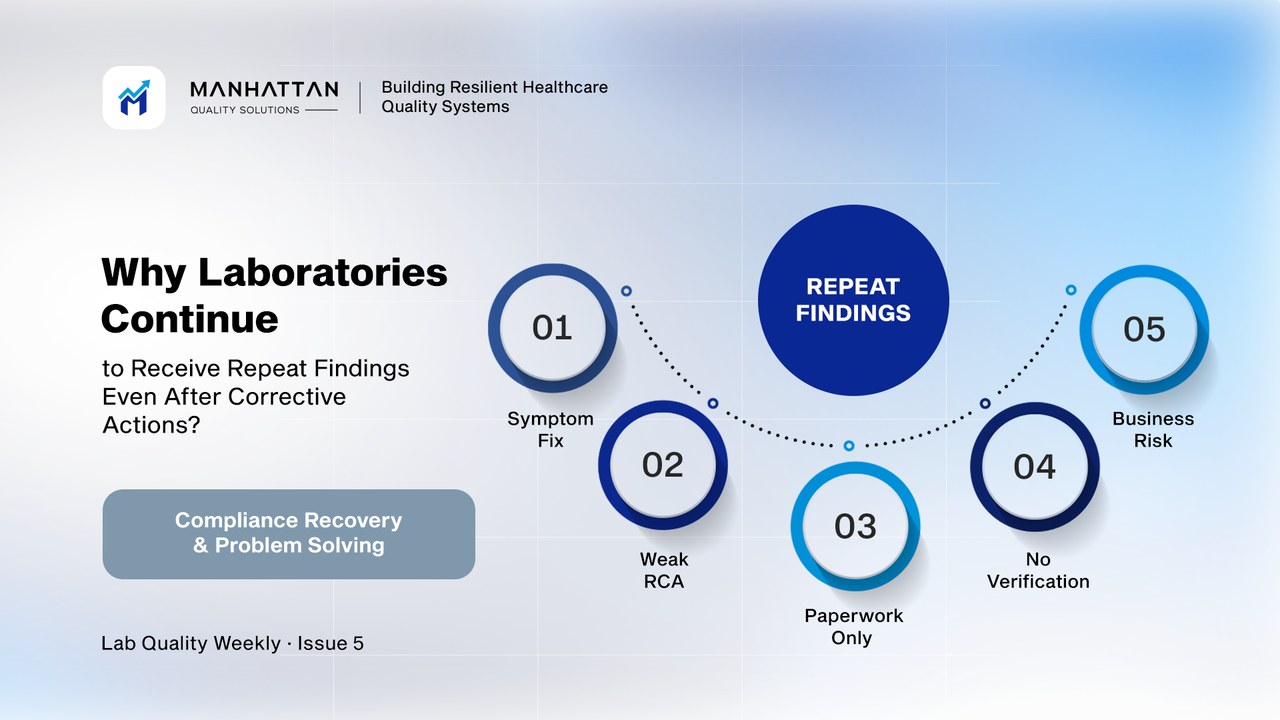
1- Why laboratories continue to receive repeat deficiencies despite closing CAPAs
2- The hidden cost of recurring findings on accreditation, reputation, and growth
3- The 7 most common root causes behind ineffective corrective actions
4- How high-performing laboratories prevent repeat audit findings
5- What inspectors, assessors, and accreditation bodies actually expect to see
6- A practical framework for building sustainable corrective actions
7- Questions every laboratory leader should ask before closing a CAPA
Many laboratory leaders believe the problem is solved once a corrective action is closed. Yet during the next CLIA, CAP, COLA, ISO 15189, or internal audit, the same finding appears again.
This is one of the most frustrating situations for laboratory directors, quality managers, technical supervisors, and healthcare executives.
- The finding was documented.
- The CAPA was completed.
- Staff were retrained.
- The paperwork was signed.
So why did the deficiency return?
The answer is uncomfortable but critical:
Most repeat findings are not caused by a failure to take action.
They are caused by a failure to eliminate the true root cause.
According to CLIA requirements, laboratories must implement and document corrective actions that ensure accurate and reliable test results. ecfr.gov
Unfortunately, many corrective actions focus on symptoms rather than systemic failures, allowing the same issues to reappear during future inspections, audits, and accreditation assessments. CAP guidance on corrective action similarly emphasizes addressing underlying causes rather than surface-level symptoms. documents-...ud.cap.org
The Real Risk Is Not the Finding. It's What the Finding Reveals.
When a repeat finding appears, auditors are rarely concerned only with that individual issue.
They are asking a much bigger question:
Can this laboratory identify, control, and improve its quality system consistently?
A recurring deficiency often signals weaknesses in:
- Quality Management Systems (QMS)
- Risk Management
- Internal Audits
- Leadership Oversight
- Staff Competency
- Root Cause Analysis
- Effectiveness Verification
From a regulatory perspective, repeated deficiencies can suggest that the laboratory's quality system is not functioning effectively, which may increase compliance concerns.
CLIA regulations require corrective action processes and documentation to support accurate and reliable patient testing. ecfr.gov
For laboratory owners and executives, the concern goes even deeper.
Recurring findings create:
- Increased inspection scrutiny.
- Higher compliance costs.
- Operational inefficiencies.
- Staff frustration.
- Reduced confidence from clients and partners.
- Delays in expansion initiatives.
- Potential accreditation risk.
Ultimately, the issue is no longer about compliance: it becomes a business risk.
Why Corrective Actions Fail
Many laboratories confuse a correction with a corrective action.
There is a significant difference.
Correction
Addresses the immediate problem.
Example:
A laboratory discovers incomplete temperature records.
Correction:
- Complete the missing records.
- Remind staff to document temperatures.
Problem fixed?
Temporarily.
Corrective Action
Addresses the reason the issue occurred.
Questions include:
- Why were the records missing?
- Why wasn't the issue detected earlier?
- Was there a process failure?
- Was accountability unclear?
- Was the monitoring system ineffective?
ISO 15189 corrective action principles emphasize identifying underlying causes, implementing proportional actions, and verifying effectiveness. pathologyl...ning.co.uk, michemdynamics.com
The 7 Root Causes Behind Repeat Findings
1. The Root Cause Was Never Identified
This is the most common reason.
Many CAPAs end with conclusions such as:
- Human error
- Staff oversight
- Employee forgot
- Training issue
These are rarely true root causes.
A well-designed quality system should anticipate human error and reduce its likelihood.
CAP experts consistently identify weak root cause analysis as one of the primary reasons findings recur. isocloudco...ulting.com, qmslearning.com
Better question:
Why was the process vulnerable to human error?
That answer usually reveals the actual root cause.
2. Training Became the Default Solution
Laboratories often respond to findings by conducting retraining sessions.
Retraining has value.
However, retraining alone rarely prevents recurrence.
Consider this scenario:
Finding: Specimens repeatedly arrive without complete documentation.
Response: Staff training.
Six months later: The same finding reappears.
Why?
Because the issue was never training.
The issue may have been:
- A confusing workflow
- Poor specimen acceptance criteria
- Ineffective forms
- Lack of automated checks
Training does not fix broken systems.
3. No Effectiveness Check Was Performed
One of the biggest CAPA failures occurs after implementation.
The action is completed.
The record is closed.
Nobody verifies whether it actually worked.
Quality systems should include measurable effectiveness verification before CAPA closure. Experts identify lack of effectiveness checks as a major cause of repeat findings. isocloudco...ulting.com, documents-...ud.cap.org
Strong effectiveness metrics include:
- Error rate reduction
- Audit results
- Turnaround time improvements
- Nonconformance trends
- Incident recurrence monitoring
Without evidence, a corrective action is only an assumption.
4. The Process Was Fixed Locally Instead of Systemically
Many laboratories fix individual incidents rather than broader vulnerabilities.
Example:
One analyzer repeatedly fails QC requirements.
Action:
Repair the analyzer.
But questions remain:
- Was preventive maintenance adequate?
- Are all analyzers monitored effectively?
- Does the current QC process identify drift early enough?
Systemic thinking prevents future recurrence.
Local fixes often do not.
5. Internal Audits Are Not Finding Real Problems
An effective internal audit should identify issues before inspectors do.
If the same finding continues to appear externally, internal audits may be:
- Too superficial
- Checklist-driven
- Inconsistent
- Insufficiently independent
High-performing laboratories use internal audits to challenge assumptions and identify process weaknesses proactively.
6. Leadership Is Not Reviewing Quality Trends
Repeat findings rarely emerge overnight.
They usually leave warning signs.
These signs may include:
- Repeated nonconformities
- Customer complaints
- Quality indicator deterioration
- Increasing corrective actions
- Proficiency testing concerns
Without management review of trends, patterns remain hidden until assessors discover them.
7. Quality Culture Is Reactive
Perhaps the most difficult issue to solve.
Some laboratories operate in continuous reaction mode:
- A problem occurs.
- A solution is applied.
- Everyone moves on.
- No one investigates why the system failed.
High-performing laboratories operate differently. Their mindset is:
"What allowed this issue to happen, and how do we ensure it never happens again?"
That shift transforms quality management from compliance activity into business strategy.
What Inspectors and Assessors Want to See
Whether the assessment is related to CLIA, CAP, COLA, ISO 15189, or another accreditation framework, assessors generally look for evidence that the laboratory:
- Identified the issue
- Determined the root cause
- Implemented appropriate corrective action
- Assessed associated risks
- Verified effectiveness
- Prevented recurrence
CAP educational materials specifically emphasize focusing on process failures, determining root causes, and evaluating action effectiveness. documents-...ud.cap.org
The CAPA file itself is not the goal.
The outcome is.
Conclusion
The laboratories that consistently succeed during inspections are not the ones that avoid findings.
They are the ones that learn from them.
A closed CAPA does not prove improvement.
A missing recurrence does.
And when the same finding appears year after year, the real question is no longer whether the corrective action was completed.
The real question is whether the laboratory was solving the problem... or simply documenting it.
If an assessor reopened your last five CAPAs tomorrow, what would the evidence reveal?
- A. Root causes were identified and permanently eliminated.
- B. Corrective actions were implemented, but effectiveness remains uncertain.
- C. Similar deficiencies continue to recur.
- D. We haven't systematically evaluated our last five CAPAs.
If you answered B, C, or D, visit our Resources hub for practical tools to make your laboratory's CAPA system audit-ready.